
Flexible acoustic panels: what the minimum radius really means
A 300 mm radius is a specification, not a promise. How the panel actually bends, where it creases, and how to plan a column or arch that will not fight you.
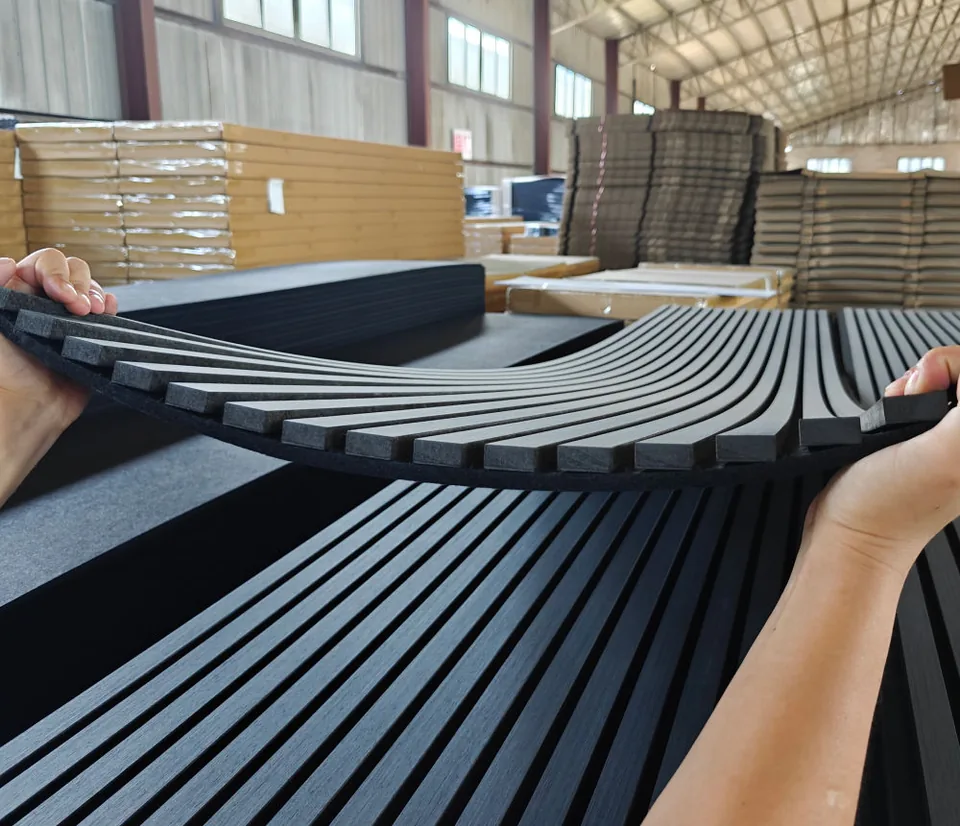
The flexible panel is the most misunderstood product we sell — usually by people who have not bent one. Our WQ-1 is specified at a minimum bending radius of about 300 mm. That number is real, but it is not the whole story.
What actually bends
The WQ-1 is 600 × 2400 × 11 mm: the same MDF slat face as the straight panel, bonded to a flexible black MDF core and a 5 mm polyester fibre felt at 900 g/m². The felt and the core bend. The slats do not — they are rigid strips running the length of the panel.
So what you are really doing is bending the panel across the slat direction. The slats rotate slightly against each other as the panel curves, which is why the panel can follow a column and a straight panel cannot.
Why 300 mm and not 100 mm
Two limits set the radius:
- The slat pitch. At a tight radius, adjacent slats close up on the inside of the curve and open on the outside. Past a certain point, the gaps close completely and the panel reads as a solid board with a crease.
- The core. The flexible MDF core has a limit to how much it can compress before the bond line fails.
At 300 mm the panel still looks like a deliberate curve. Below that, it looks like a panel that was forced.
The 620 mm column case
The most common enquiry is wrapping a structural column. A 620 mm diameter column has a radius of 310 mm — just outside the comfortable range. In practice:
- A 600 mm panel wraps about 110° of that column. Four panels wrap it completely with a joint that can be hidden behind a shadow gap or a reveal.
- Do not try to wrap one panel more than 120°. Ordering narrower strips and treating the column as a segmented polygon always looks better than forcing a tight continuous bend.
- Start the wrap from the least visible side. The joint where panel one meets panel four is the one that shows.
Where the panel creases
Three failure modes, all avoidable:
Bending along the slat direction. The panel will not bend that way. It will kink. If your design needs a curve running parallel to the slats, the answer is a segmented install, not a bent panel.
Over-tightening the fixings. Screws driven too hard compress the felt locally and create a flat spot on the curve. Drive them to contact, not to torque.
Cold installation. The felt and core are stiffer at low temperature. Below about 10 °C, the panel is harder to bend and more likely to crease. If you are installing in an unheated building in winter, let the panels sit in a warm room for 24 hours first.
Planning an arch opening
An arched opening is a curve with a changing radius, and the panel is not a stretchable material. Practical approaches, in order of how well they look:
- Segments. Cut the panel into 100–150 mm wide strips and install as a faceted arch. With the slats running consistently, the result reads as a curve from two metres away.
- Single bend on a constant-radius section, segments at the tight ends. Most arches have a constant middle and tight corners — this hybrid works well.
- Straight panel with a trim line. Honest and cheap: stop the panel at the springing line, finish the arch in plaster or timber. On many projects this is the correct answer and no one notices.
What to send us
For a curved project, we need the radius, the height, the arc length or the angle to be covered, and a photograph or sketch. From that we will tell you whether it is one panel, four panels or segments — and we will say so if the answer is "do not bend this, use trim".
Ask for a sample. We can send a short offcut of the WQ-1 and you can bend it yourself before you commit to a 400 m² order. That five-minute test has saved several projects.
Ask about your own project
Send the room dimensions and the complaint. We will answer with a panel schedule and an FOB price — and say so if a panel will not solve it.